Which SANTINY skort length lands where on your leg
A 14-inch tennis skirt and a 20-inch golf skort are two different pieces for two different days, and a photograph of a model whose height you do not know cannot tell you which one covers your knee. What a skirt length is, how to measure a piece you own, where each of the seven lengths on this site ends on a leg, and what the shorts underneath do about it.
What a skirt length is, and what it is not
A skort length is a measurement on the garment, not on your body. Measured from the top of the waistband to the hem, that single figure tells you where the fabric will fall relative to a waistband that sits high. One yardstick serves a pleated tennis skirt and a golf skort alike. Do not think of the length as a rule for your leg. The same 16-inch or 18-inch number will land differently if you are taller or shorter, and the skirt will not change its number to match your height.
When you look at a label that reads 14, picture the garment laid flat and the tape running from the top of the waistband to the hem. The waistband sits high on most of our pieces, and that decides how much fabric falls over the thigh. Pleats, ruffles and panelling move the eye, but they do not change the basic measurement. The pleated tennis skirts sit at 13.5 and 14, closing into flat folds when you stand and opening when you step. Plain tennis skirts come at 14, 15 and 16. Golf skorts are offered at 14, 16, 18 and 20. Keep the measurement in mind as a descriptor of the garment itself, not as a promise about any particular leg.
When you pick a length, you are choosing how much fabric falls from the top of that high waistband, and nothing else.
How to measure one from a skirt you already own
If you have a skirt or skort that fits the way you like, measuring that garment gives you the clearest idea of which number to choose next. Lay the skirt flat on a table or other firm surface, smooth out any wrinkles and make sure the waistband lies flat. Place the end of a tape at the top of the waistband and run it straight down to the hem. That measurement, taken on the garment, is the skort length as we use it. Do not measure along a leg or try to estimate from how a skirt looks on a body, because height changes where a hem lands.
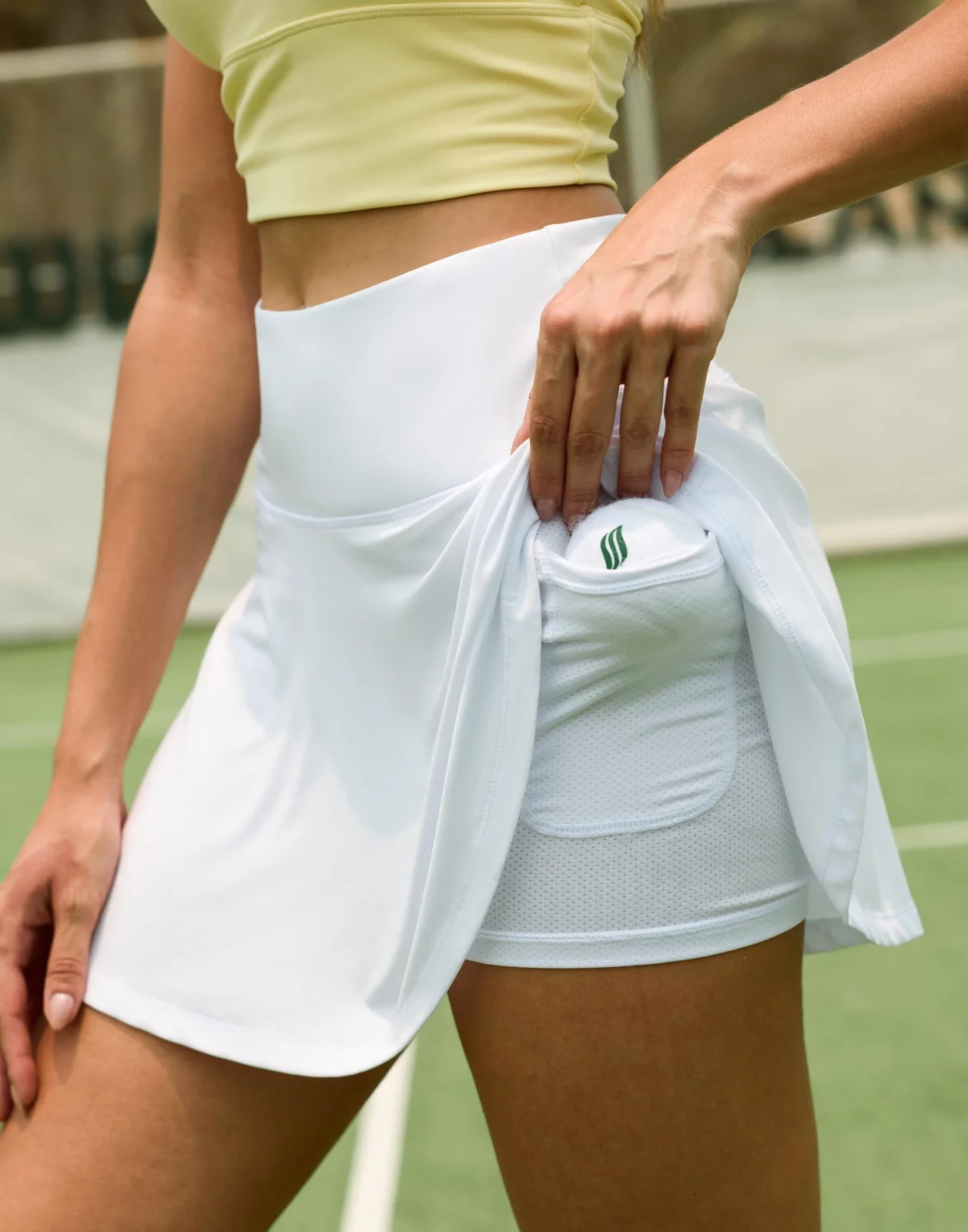
When you take the tape, do not fold the skirt or pull the fabric taut. Measure the front centre if you want a single, comparable number, and measure every skirt the same way, so a pleated tennis skirt at 14 and a plain one at 14 are being compared like for like. The waistband sits high across most of our skorts, and that decides how much fabric covers the thigh or reaches the knee. If the skirt you own has fitted shorts sewn in underneath, the shorts usually end an inch or two above the hem, and the pockets, when present, sit on those shorts and keep a phone flat against your thigh.
If you do not have a comparable garment, measure a skirt that hits where you like, or measure from the rise point on a well-fitting item to the hem. That will put you close to a length that lands where you prefer it.
The court lengths: 13.5, 14, 15 and 16 inches
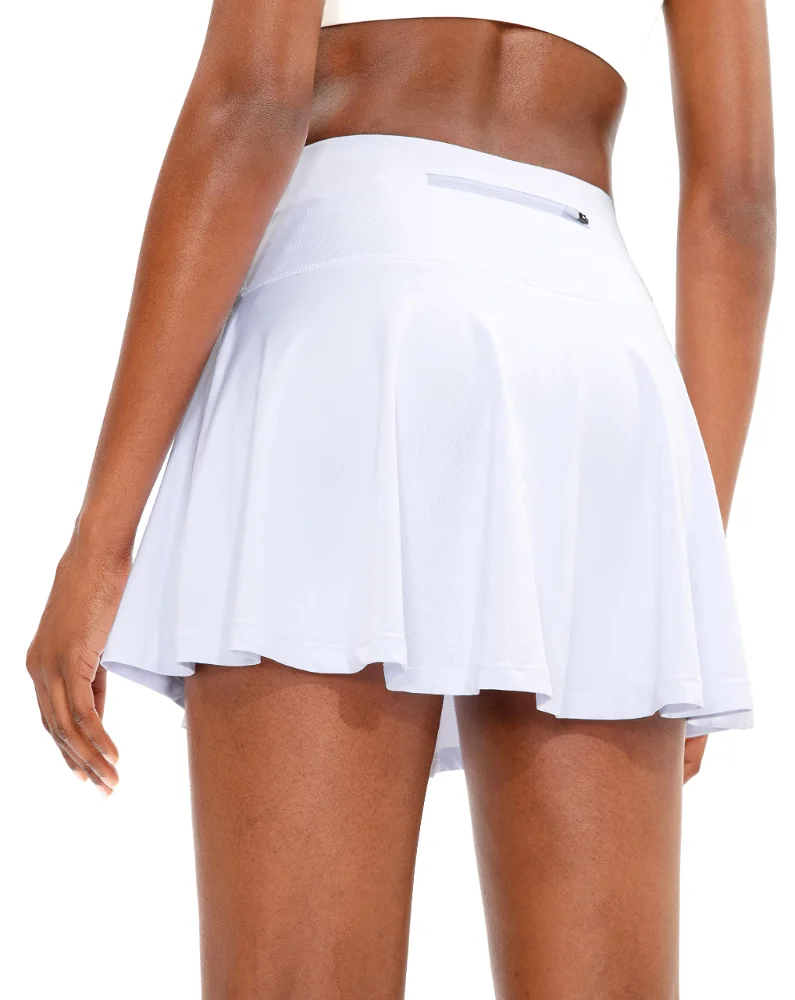
The shorter lengths are shaped for play on court surfaces, and each number has a predictable relationship to a waistband that sits high. The pleated tennis skirts are offered at 13.5 and 14 inches. Those pleats hang in flat folds all round, opening as you step and closing when you stand, so a 13.5 will read as a compact pleated skirt that moves. Plain tennis skirts come at 14, 15 and 16 inches, giving you small increments to change how much thigh the hem reveals.
On a height around five foot five, a 14-inch length ends high on the thigh. A 16-inch length sits roughly a hand above the knee for someone of that height. The same numbers sit about two inches higher on a height around five foot ten. That means what looks short on one frame will shift upward on a taller one. If you prefer a skirt that behaves like a court piece while still offering a touch more coverage, a 15-inch plain tennis skirt provides a midpoint between the high-thigh of a 14 and the higher-knee approach of a 16.
The cargo skorts also come at 14 and 16 inches, so the pockets on the fitted short underneath sit in the same place when you choose those numbers. The waistband height remains a constant factor, and the shorter court lengths keep movement and swing in mind.
The golf lengths: 18, 19 and 20 inches
On-course lengths push a hem toward the knee and below. For reference: 18 reaches the top of the knee on a height around five foot five, 19 sits between the top of the knee and just above it depending on styling, and 20 covers the knee at that height. A height around five foot ten will see each of those lengths land about two inches higher, which changes how much of the kneecap receives fabric.
| Length | Where it lands on a height around five foot five | The day it suits |
|---|---|---|
| 18 inches | Top of the knee | A long round of golf in warm weather |
| 19 inches | At or just above the knee | A ruffled option for a day with extra movement |
| 20 inches | Covers the knee | A day when you prefer a knee-covering skort |
An 18-inch golf skort has been chosen by a buyer around five foot ten for golf in Florida heat, who noted the shorts underneath did not ride up. The ruffled 19-inch skirt is listed at that length, and a buyer at five foot one reported the 19-inch ruffled skirt landed above the knee. Golf skorts are also made at 14 and 16 inches in addition to 18 and 20, so you can choose how much of the thigh you want visible while keeping the same high waistband.
What the shorts underneath do about it
Every SANTINY skort contains a pair of fitted shorts sewn in underneath the skirt. Those shorts finish an inch or two above the hem of the skirt, creating an internal layer that moves with you. When pockets are present, they are placed on the fitted shorts rather than on the outer skirt, so a phone or small items lie flat against the thigh and do not shift independently under the hem. The built-in shorts reduce the need to think about a separate base layer when you are active.
You will notice that the shorts influence how a skirt feels in motion. Because they are fitted, they anchor the skirt and control the way pleats and ruffles open and close. A buyer at five foot ten reported that an 18-inch skort gave the coverage sought for golf and that the shorts underneath did not ride up during play. The shorts also determine pocket placement, and pockets are intentional: where there are pockets, they are on those shorts so weight sits close to the body.
The shorts are the working core of the skort: they carry the pockets, they end an inch or two above the skirt hem, and they are what you feel against the thigh when you sit. The skirt over them carries the length number and nothing else.
Height changes where a hem lands, and the number does not
A length number is fixed on the garment, and height changes how that fixed length meets your leg. The 14-inch, 16-inch, 18-inch and 20-inch figures will not adapt to your height. Instead, your frame determines whether the hem reads high on the thigh or settles at the knee. On a height around five foot five, for example, 14 ends high on the thigh, 16 sits a hand above the knee, 18 reaches the top of the knee and 20 covers it. If you are around five foot ten, each of those numbers will sit about two inches higher on your leg.
Use those reference points to predict where a hem will fall, rather than assuming a number means the same on every body. Consider the waistband height too, because a high waistband shifts the total drop of fabric. Sizes run from XS to 2XL on most skorts, with an across-the-shelf spread of XXS to 3XL, and the waistband position is consistent enough that those size ranges do not alter where a hem lands in major ways.
A few buyer notes underline the pattern. One buyer at five foot four said a 16-inch skort hit at mid-thigh. Another at five foot one reported that a 19-inch ruffled skirt landed above the knee. Use a skirt you already like as a measuring tool, remember that the measurement is from the top of the waistband to the hem, and expect the same number to read differently as your height changes.
More of this sort of thing is in Shore Notes, the people at SANTINY keeps the whole range one click away on the front page, and the sources behind every sun and label claim are listed on how we update the catalogue.